


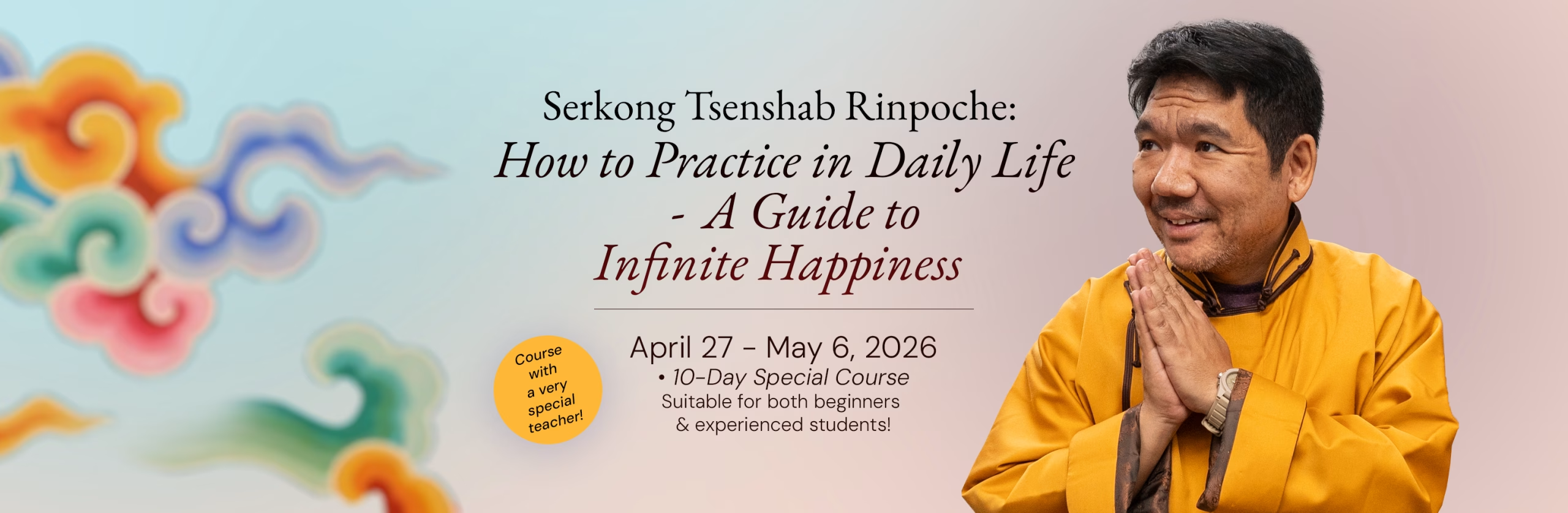
Serkong Tsenshab Rinpoche: How to Practice in Daily Life – A Guide to Infinite Happiness
27 April – 6 May 2026
This special 10-day residential course is open to all levels of practitioners: beginners and experienced alike.
We are extremely honoured and delighted that Serkong Tsenshab Rinpoche accepted our request to give His second 10-day course at Tushita!
We don’t know how to bring the Lam Rim, the stages of the path to enlightenment, into everyday life. There is a lot of doubt about it that we need to clear out.
Most important is, when we say Lam Rim in day to day life, to get people interested in this topic, to clear the doubts about it. The doubts that the Lam Rim is too long, too hard and it takes time forever. So we need to go little by little, very gently, very softly.
Sometimes some people, many people, think that Lam Rim is a gelugpa practice, but then they want to find another practice which is easier or more down to the core of the Buddhist teachings, like a shortcut and more profound. But the bad news is that they don’t find it!
So (in this course) we will go through some parts of the Lam Rim and discuss them. Maybe we go through some lines from Lam Rim Chenmo* and then we can go freestyle as well.
*The Great Treatise on the Stages of the Path to Enlightenment by Lama Tsongkhapa
Serkong Tsenshab Rinpoche on the auspicious occasion of Lhabab Düchen, on November 22, 2024.
Teacher
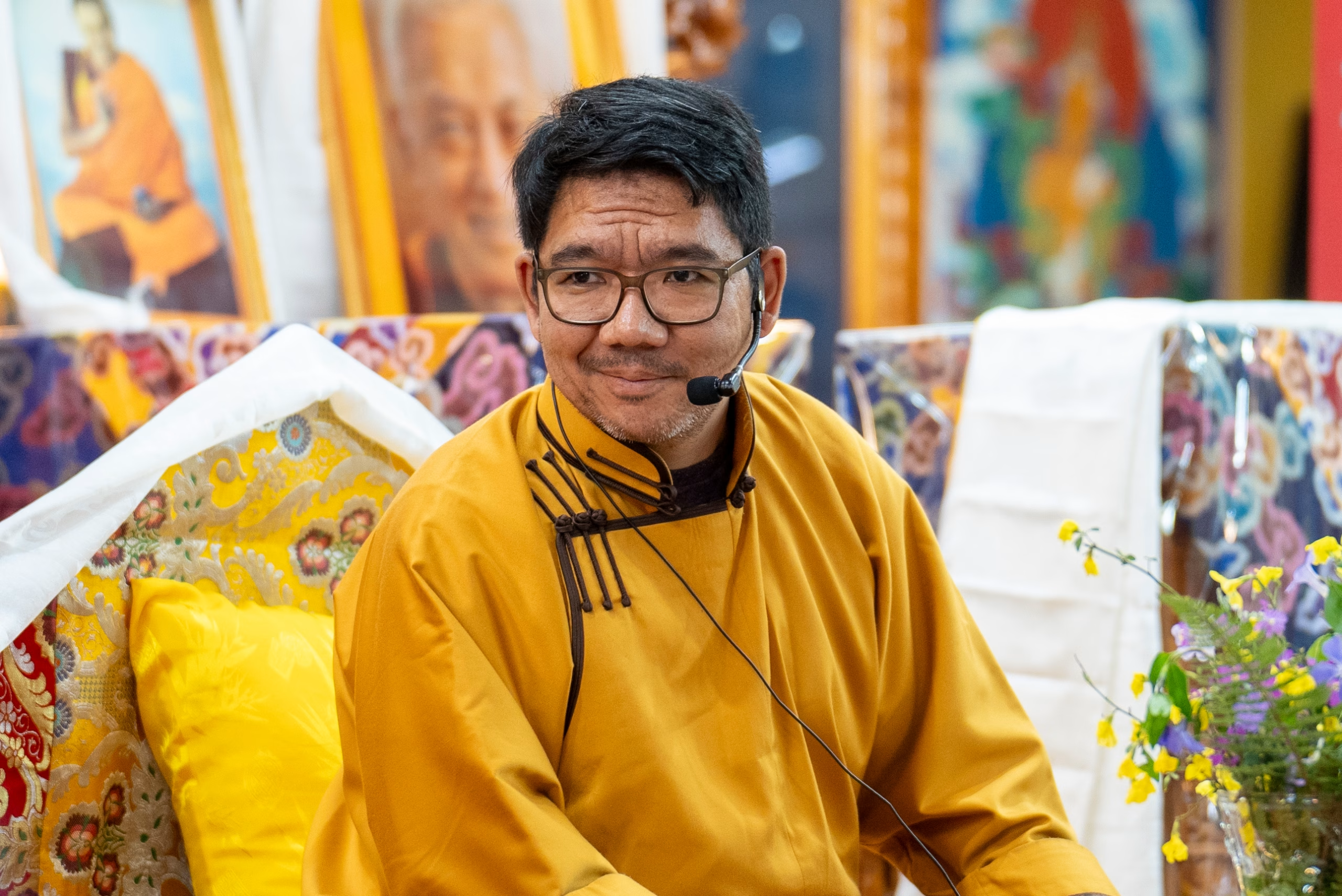
At the age of two, Serkong Tsenshab Rinpoche (1984 – present) pointed to a photo of the recently deceased Assistant Tutor of the 14th Dalai Lama and said, “That’s me!” When he was about three years old he was recognized by His Holiness the Dalai Lama as the incarnation of Kyabje Tsenshap Serkong Tugse Rinpoche (1914-1983), who was one of the seven master debate partners to His Holiness the Dalai Lama.
Rinpoche began his Buddhist studies and training at Ganden Jangtse Monastery in South India. After deciding to continue his work for the Dharma as a lay person, he completed his education at the Institute of Buddhist Dialectics in Dharamsala. On the advice of the Dalai Lama, Rinpoche completed three years of intensive study of English in Canada.
Currently, Rinpoche teaches at Dharma Centers worldwide, combining his profound Buddhist knowledge and practice with an understanding of the modern world. His captivating teachings are characterized by wisdom, humility and humor. Rinpoche considers it an honor to carry on the teachings and responsibilities of Tsenshap Serkong Tugse Rinpoche, striving to benefit others to the fullest extent possible.
To learn more about Rinpoche’s teachings and projects, please visit Serkong Institute for Buddhist Studies website.
The following is a fascinating excerpt describing Serkong Tsenshab Rinpoche’s previous life and reincarnation written by Alexander Berzin, His Western main disciple from His previous life. For more, visit the Berzin Archive’s “Portrait of Tsenzhab Serkong Rinpoche.”
A Portrait of Tsenshab Serkong Rinpoche
Alexander Berzin, 1998
Part Eight: Rinpoche’s Death and Rebirth
Potential Danger to His Holiness the Dalai Lama’s Life
Serkong Rinpoche’s death was even more remarkable than his life. In July 1983, Rinpoche organized His Holiness the Dalai Lama’s conferring of the Kalachakra empowerment at Tabo Monastery in Spiti. Afterwards, Rinpoche mentioned to a local old monk, Kachen Drubgyel, that according to Tibetan astrology this was His Holiness’s obstacle year. His Holiness’s life was in danger. It would be good to transfer these obstacles onto himself. He told the old monk not to mention this to anyone.
Rinpoche then entered a strict meditation retreat for three weeks. Afterwards, he went to a nearby Tibetan army camp to teach the soldiers Engaging in Bodhisattva Behavior. Rinpoche was supposed to teach the entire text slowly over an extended period, but rushed through it
quickly. Leaving the camp several days earlier than planned, he explained that he had somewhere special to go. This was the day, August 29, 1983, that His Holiness was flying to Geneva, Switzerland, at the same time as Yassar Arafat, Chairman of the Palestine Liberation Organization, was also expected to arrive there. The police authorities were concerned about a possible act of terrorism directed against Arafat. They warned that they could not guarantee His Holiness’s security.
Preparing to Take on Himself the Obstacles to His Holiness’s Life
Rinpoche and Ngawang sped off from the army camp in a jeep, stopping briefly at Tabo Monastery. Rinpoche asked Kachen Drubgyel to join them, but the old monk explained that he had just washed his robes. Rinpoche said it did not matter, but to come in his underskirt. He could tie his robes to the top of the jeep to dry, which the old monk did.
As they drove deeper into Spiti Valley, Rinpoche told Ngawang that he had always told him to repeat continually the mantra of compassion, om mani padme hum, but that he never took him seriously. This was to be his parting advice.
They then stopped at Kyi Monastery. Rinpoche wanted to make offerings. Ngawang said it was late and that they could go in the morning, but Rinpoche insisted. Most of the time, Rinpoche walked slowly and with difficulty. On occasion, however, Rinpoche was quite able to run. For
instance, once at an airport, when we were almost late for a flight, Rinpoche ran so quickly, none of us could keep up with him. Similarly, once in Bodh Gaya, when His Holiness was participating in a mass recitation of the hundred-volume Tibetan translation of Buddha’s words (the Kangyur), Rinpoche sat to the side of His Holiness, with me right behind. When the wind carried away a page from His Holiness’s loose-leaf text, Rinpoche practically flew from his seat to pick it up instantly from the floor. Normally, he required assistance to get up. On this occasion at Kyi Monastery, Rinpoche also ran quickly, unassisted, up the steep mountain trail.
After Rinpoche had made his offerings, the Kyi monks requested him to spend the night there. Rinpoche declined, saying he had to reach the village of Kyibar that night. If they wanted to see him again, they would have to go up there. He then left quickly, having given this indirect message of what was about to happen.
When Rinpoche and his party reached the high village of Kyibar, they went to the house of a farmer he knew. The man was still out in his fields and did not expect any guests. Rinpoche asked if he were busy for the next week or so. The farmer said no and invited Rinpoche to stay.
The Evening of Rinpoche’s Passing Away in Meditation
After washing himself and eating some yogurt, Rinpoche recited from memory Tsongkhapa’s The Essence of Excellent Explanation of Interpretable and Definitive Meanings, which took him about two hours. When he finished, he called Ngawang and said he was not feeling well. He then put his head on Ngawang’s shoulder – something that Rinpoche normally never did. It seemed, in retrospect, that he was saying farewell. He had sent Chondzeyla away to Simla before all this, since it would undoubtedly be too difficult for Chondzeyla to witness what would happen. He had been with Rinpoche since he was six years old and Rinpoche had raised him like his son.
Ngawang asked if he should get a doctor or some medicine, but Rinpoche said no. Ngawang asked if there were anything else he could do, and Rinpoche asked him to help him walk to the toilet, which he did. Then Rinpoche asked Ngawang to make his bed. Instead of the usual yellow
sheet that he always slept on, Rinpoche asked Ngawang to lay out a white one. In tantric practice, yellow is used for rituals to increase one’s ability to help others, whereas white is for pacifying obstacles.
Rinpoche then requested Ngawang and Kachen Drubgyel to come to his bedroom, which they did. Rinpoche then laid down on his right side, in the Buddha’s sleeping posture. Instead of holding his arms in the standard position of left on his side and right under his face, as he normally did when going to sleep, he crossed them in the tantric embracing gesture. He then began to breathe deeply and simply passed away, apparently through the meditation process of “giving and taking” (tonglen). He was sixty-nine and in perfect health. I had taken him for a thorough medical examination in Delhi two months earlier.
At precisely that moment, while His Holiness was still in flight on route to Geneva, Chairman Arafat suddenly changed his mind and decided to postpone his visit to Switzerland. The danger of a terrorist incident at the airport was thus averted. Although the danger to His Holiness’s life
was gone, still His Holiness’s motorcade became lost on the way from the airport to the hotel. However, His Holiness avoided any harm. Serkong Rinpoche had successfully taken on the obstacle to His Holiness’s life and given in turn his own life-energy.
The Giving and Taking Meditation Rinpoche Used for Taking On the Obstacles
Giving and taking is an advanced bodhisattva technique for taking on obstacles from others and giving them happiness. Whenever Rinpoche taught this practice, he said that we need to be willing to take on the suffering of others even if it meant to the point of sacrificing our lives. He always referred to the example Kunu Lama Rinpoche had given of a person in his home district who took on someone’s head injury and consequently passed away. When we asked Rinpoche if he were to do this, would it not be a waste, Rinpoche would reply, no. It would be like an astronaut, he explained, who sacrificed his life for the sake of world progress. Just as the example and fame of the heroic astronaut would assure a substantial government pension for his family, so too the heroic example of the lama’s sacrifice would provide for the spiritual nourishment of his disciples left behind.
Remaining in Death-Juncture Meditation for Three Days
Serkong Rinpoche remained in the death-juncture meditation on clear light for three days. Those with the ability to direct their rebirths normally enter this meditation as part of the process of either generating or continuing a line of reincarnate lamas. During the meditation, their hearts remain warm and their bodies do not start decomposing although they have stopped breathing. Normally, the great lamas remain in this state for several days, after which their heads slump and blood leaves the nostrils, indicating that their consciousness has left their bodies.
When these signs occurred with Serkong Rinpoche, rainbows glimmered in the sky and wondrous lights appeared on the barren hill chosen for his cremation. Although people sent word to His Holiness’s Namgyal Monastery in Dharamsala for monks to come for the cremation ceremony, the party could not arrive in time. The Spiti monks performed the rites, modestly, as Rinpoche would have wished. Shortly afterwards, a fresh water spring with healing powers spouted from the cremation site. Still flowing today, it has become a place of pilgrimage. Exactly nine months later, on May 29, 1984, Rinpoche took birth once more, again in Spiti, in a humble family.
Directing his Rebirth
Several years before, Rinpoche had met a husband and wife named Tsering Chodrag and Kunzang Chodron, both of whom had impressed him greatly. Very strong Dharma practitioners, they had told Rinpoche that their deepest wish had been to become a monk and a nun. The headman of the local villages had recommended against this, since joining the monastic life as adults with a young family would present many problems. They must look after their children first. Rinpoche seconded the headman's counsel. These were the parents Rinpoche took birth with, as their fourth child.
Disciples use various means to locate the reincarnation of a great lama who has mastered death-juncture meditation. These methods include consulting oracles and the dreams of the most highly realized masters. The final candidate then needs to identify correctly several possessions of the
deceased lama from among many similar-looking items. His Holiness the Dalai Lama, however, warns not to rely solely on such means. The child needs to give clear signs of his or her identity before being considered a serious candidate.
Identifying Rinpoche’s Reincarnation
The people of Spiti regard Serkong Rinpoche similar to a saint: almost every household contains his photograph. As soon as the little Serkong Rinpoche could talk, he pointed to Rinpoche’s picture on the wall of his parents’ home and said, “That’s me!” When Ngawang later visited the
house to check out the child, the boy immediately ran into his arms. He wanted to go with him back to his monastery.
No one had any doubts about who he was. After all, a few years earlier a group of prominent Spiti women had requested Rinpoche to take rebirth in their valley next time. Receiving permission from the Indian government to visit their remote border district had always been a problem. Such a rebirth would make everything easier. His parents, deeply honored, gave their consent and, at the age of four, the little Rinpoche left for Dharamsala. Although his parents visit him from time to time, the boy has never asked for them, nor has he seemed even to miss them. From the start, he felt perfectly at home with the members of his old household. They were his heartfelt family.
The Young Reincarnation Recognizing Me at Our First Meeting
I was out of India on a lecture tour when Rinpoche first arrived in Dharamsala. A few months later, upon my return, I went to see him, trying to be neither overly expectant nor overly skeptical. As I entered Rinpoche’s room, Ngawang asked the boy if he knew who I was. The lad replied, “Don’t be stupid. Of course, I know who this is!” Since a photograph of me translating for a meeting in the Vatican between the old Serkong Rinpoche and His Holiness the Pope hung prominently on his sitting room wall, I thought perhaps he recognized me from that. Yet, from the moment we met, little Rinpoche treated me with total familiarity and ease, like a family member. A four-year-old child cannot fake something like that. This, more than anything, has convinced me of who he is.
The Fourteen Year-old Rinpoche in 1998
Now, in 1998, the new Serkong Rinpoche is fourteen. He lives and studies mostly at his monastery in Mundgod and comes to Dharamsala once or twice a year, when His Holiness gives major teachings. Chondzeyla and Rinpoche’s old cook have died and Ngawang has disrobed, married, and now lives in Nepal. Rinpoche has a new household of monks to care for him, all of whom he handpicked in his former life. For example, he personally chose two ten-year-old boys from Spiti and Kinnaur to join his household and attend him during the last few months of his
life.
Although he has a similar sense of humor to that of his predecessor and shares the same practical down-to-earth approach, the young Serkong Rinpoche has his own personality. What continue from one lifetime to the next are the talents, propensities, and karmic connections. In my
relationship with him, I feel somewhat like a member of Captain Kirk’s original Star Trek crew who has now joined Captain Picard of Star Trek: The Next Generation. Everything has changed and yet there is definite continuity.
Taking a Back-Seat Role in Rinpoche’s Upbringing
So far, I have taken a back-seat role in Serkong Rinpoche’s upbringing. I have felt that the old Rinpoche would have wished mainly to serve his own people. Too many great lamas have devoted themselves to teaching in the West or in areas of Asia outside their traditional cultural sphere, to the detriment of the Tibetans themselves. If the Tibetan form of Buddhism is to survive in its fullest form, training future generations of Tibetans is essential. This is because, at present, the complete Buddhist teachings are available only in the Tibetan language. Rinpoche provided me with the best circumstances imaginable for my training and self-development. To repay his kindness, I have sought to do the same for him.
To try to prevent cultural conflict, I have not participated in Rinpoche’s modern education. In fact, I have purposely avoided having too much contact with him, although the close bond between us is strikingly evident whenever we meet. Instead, I have helped to arrange local Tibetan instructors to teach him English, science, and social studies, following the same curriculum the Tibetan schools in India use. Consequently, Rinpoche can fully relate to his own people. I have also neither taken him to the West nor bought him a computer or a video player, and I have discouraged others from offering him these. Too many young reincarnate lamas find computer games and action videos more enticing than their traditional monastic studies.
Prayer to Become His Disciple Once More
I do not know how much my direction has contributed, but Rinpoche displays a deep sense of security and is fully comfortable in his own culture. This can only be of benefit to him and to everyone he will meet in the future. He can learn firsthand about the West when he reaches maturity. I pray that I can become his disciple once more in my next life.
Course Details
This course requires a non-refundable/ non-transferable deposit. See our Frequently Asked Questions for more information on this. Please only register if you can make this deposit promptly!
Please visit these links for general information about our residential courses, especially the retreat environment.
Course Schedule
Our 10-day courses begin at 1pm on Day One, and end at 1pm on Day Ten. The days in between begin with a wake-up gong at 6am and the last session of the day ends around 9pm, with teaching and meditation sessions throughout the day. There are breaks for 3 meals, possible stretching session and a one hour “discussion group”.
For more detail, visit our page – Typical Introduction to Buddhism Course Schedule.
Please be aware that this might change on short notice!
Adjusting to the Retreat Environment

A course of spiritual study and meditation takes energy, commitment, and discipline. It’s a space in which to shut out the distractions of everyday life and come face-to-face with yourself. That isn’t always easy, especially for beginners.
Body and mind are not used to these very different circumstances and may react with discomfort, restlessness, boredom, doubt, criticism, fatigue or sudden, unfounded concerns. Preparing yourself by anticipating these reactions, and committing to stick to the discipline of retreat even if they arise can be transformatory. Therefore, we have to adjust ourselves to the retreat settings:
- We have to adjust to keeping silence. Silence is kept throughout the course, however during teaching sessions questions are welcomed and there will be a one hour discussion group on most days.
- We may experience a lot of ups and downs during the course. Therefore, please be gentle in your behaviour and sensitive to fellow course participants and staff.
- We have to keep an open mind. Many of the ideas presented may be new and different from one’s own beliefs, and we should be prepared to analyse and contemplate not only the teachings, but also our own beliefs.
- We have to adjust to the schedule: all participants must attend all sessions of the course, come to sessions on time and not leave Tushita property for the duration of the course.
Please follow this link for more information about The Retreat Environment.
Preparing for the Course
Complete all your outside communication and arrangements before you arrive for check-in
In order to successfully participate in the course, you must be really free from all outside commitments for the entire period of the course. All phone calls, e-mails, letters, tickets, flight confirmations, money changing etc must be arranged and organised before the course begins. There is no way to do this during the course, so be sure to tell your family and friends that you won’t be in touch until after check-out on the last day of your course (after 1pm). Your phone has to be deposited with us for safe keeping during the course. Our Retreat Environment page explains why this discipline is important.
You must be in good general health, both physically and mentally, to attend this course
If you feel unwell before the course, please seek medical advice before coming here. If you take part in the course while feeling unwell you will not be able to participate fully and are more likely to prolong your sickness by over-exerting yourself. In addition, we run large courses with shared facilities and have to act responsibly for the welfare of our students; therefore if you have been feeling unwell and have not yet received medical advice, we will ask you not to join the course. This applies most especially to those with stomach problems or flu-like symptoms. We recommend you that read our more detailed information about Health & Safety.
We’d like to stress that meditation involves observing the mind with greater focus than in everyday life, and our Introduction to Buddhism courses present psychological ideas which people may find challenging. Our courses provide tools to help students to process these challenges themselves, but we are not psychologists/counselors, and we have large courses so cannot provide individual counselling. This course / practicing meditation is not a substitute for professional counseling.
During the course, be prepared to live simply
For example:
- Due to water shortages in this area we ask course participants not to do their own laundry. We have an inexpensive and good quality laundry service available, for more information available on our Laundry Service page.
- We serve three vegetarian meals a day. We cannot cater for special dietary needs (such as vegan diet, lactose or wheat allergies). More information is available on our meals page.
- Most accommodation is dormitory style. Simple, clean and comfortable. Please note that accommodation cannot be booked in advance. More information is available on our accommodation page.
Make sure that you have brought everything you’ll need
- A photocopy of your passport and current Indian visa for check-in (non-Indian citizens only).
- Warm clothing, which can be worn in layers, and a good sleeping bag. Due to monastic and local customs, the body should be completely covered from the shoulders to below the knees, including the upper arms. No tight or revealing clothing please.
- Personal toiletries, towel, torch/flashlight, watch/clock (you cannot use your mobile phone for this, or as an alarm), refillable water bottle.
- Extra money (usually 1000 rupees is enough) to have with you for library deposit for book loans (600 rupees per book), and for some purchases (toiletries, biscuits etc.) which can be made during the course at our small shop in the office.
- It’s not required, but you might find it helpful to take a look at our Introduction to Buddhism course materials, recommended reading list or multi-language Dharma glossaries.
For a more extensive list, please refer to our page – What to Bring.
Guidelines for Behaviour
Rules of Discipline
It is only possible to stay at Tushita if you are taking one of our residential courses/retreats or are an established Buddhist practitioner doing your own formal Buddhist retreat of a minimum of 10 days duration.
Since Tushita is a semi-monastic meditation centre and not a guesthouse, we ask all of our retreatants and visitors to observe the following rules of discipline in order to maintain an atmosphere conducive to inner reflection and meditation:
- Be considerate of the monks and nuns: dress respectfully (please no shorts above the knee, tank-top shirts or tight and revealing clothing).
- Respect all life: do not intentionally kill any living being, even small insects.
- Respect others’ property: do not steal or take anything not freely given.
- Be honest and straightforward: do not lie or intentionally deceive others. This is easy when observing silence!
- Be celibate: no sexual activity. This also includes no holding hands, hugging, massages and other physical displays of affection.
- Be alert and mindful: avoid intoxicants such as alcohol, drugs and cigarettes (we encourage you to stop smoking while here, but if this is impossible, one can smoke at a designated place at the centre boundary).
- Be considerate of others’ silence: keep silence in the appropriate areas and at all times during residential courses, especially in the Gompa and the dormitories. No singing or playing music and in general, maintain a quiet demeanor while on the property.
Basic Course Discipline
In order to keep the atmosphere conducive to inner reflection and spiritual pursuit and to minimise distractions during the course, students on our residential courses and retreats are asked to abide by our basic code of discipline listed below.
- Please be gentle in your behaviour and sensitive to fellow group members.
- Please settle all outside communication before the course begins. Telling friends and family that you will be out of contact for the duration of the course and sticking by that decision significantly reduces distraction from investigation into the workings of your own mind! Likewise, please settle your travel arrangements etc before you come to Tushita!
- You are expected to observe silence (no talking at all) from the evening of the first day until the end of the course.
- Do not leave Tushita property for the entire course.
- Participants must attend all sessions of the course and come to sessions on time.
- Please put all communication / entertainment devices (laptop / mobile phones /cameras / MP3/CD players) etc into our safe at check-in.
Gompa Etiquette
“Gompa” is a Tibetan word which we use for Meditation Hall. Because a Gompa is the location of study, meditation and devotional practices, Buddhists consider them to be holy places. In this tradition, the following modes of behaviour are considered respectful in a Gompa and we ask you to follow them while here:
- No idle chit-chat in the Gompa (ie. You can ask the teacher questions during class, but do not talk with other students).
- Do not point your feet towards the teachers, the altar or any holy object.
- Do not put Dharma materials – prayer books, texts, Dharma books or notebooks with Dharma in them – on the floor, or sit or step over them.
- Do not lie down or do any yoga exercises in the Gompa at any time.
Registration
This course is not something “just for fun” or to tick off on a travel itinerary. It is a serious course. However, if done properly it can be a challenging, but fulfilling and highly enjoyable experience.
Many people are not sure what to expect and that is all right. However, please only register and attend this course if you intend to participate fully in a serious and committed manner. We understand that following all these rules, and especially keeping the silence, can be difficult, but it is an essential part of the course experience and the staff are here to help and support you in keeping to the rules, in order to aid and maintain the retreat environment.
This information in convenient, printable form: Tushita Post-Registration Handout – PDF.
- To register for an Introduction to Buddhism course, please read ALL of the above and below information about the course.
- Then complete the online registration form in the Registration section of this website.
- Please don’t email just to ask about availability on the course; there will be enough space (unless indicated on our homepage that this course is full and has a waiting list) and you’ll save both yourself and Tushita volunteers time and effort by just completing the form.
- For details on the waiting list, see FAQs > “What is the waiting list and how does it work?”
- For our student’s convenience and to make the Dharma teachings as accessible as possible we keep this registration process as simple as possible.Unfortunately up to 50% of the people who register don’t show up for courses! This results in long waiting lists and a lot of uncertainty. Therefore places on all our residential courses / retreats will now be confirmed only after a non-refundable / non-transferable (to different course or person) deposit is received from the applicant. See this FAQ for more information.
- If after registering you realize you cannot attend this course please let us know asap about your cancellation, so we can give your spot to somebody else. In case you Confirm and then don’t show up to the course, you will be considered as a “No Show”. After two “No Shows” you will be prohibited from registering for future courses.
- Check-in time is 1pm on the first day of the course. If you don’t arrive on time, you may lose your place to people on the waiting list.
- Most of our accommodation is dormitory-style and rooms can NOT be booked in advance. We have a very small number of single rooms, and a very high demand for them. Please let us know if you are of a mature age (i.e. over 50) or have a physical condition which would prioritise you for a single room; although we can’t guarantee any particular kind of room, we will do what we can to make you comfortable given our limited resources. See this link for more information about how our room allocation system works.
For other queries, like donation and refund policy, please visit Frequently Asked Questions.
Registration
Register by filling out our online form
Please make sure you have read the information on this page first.