


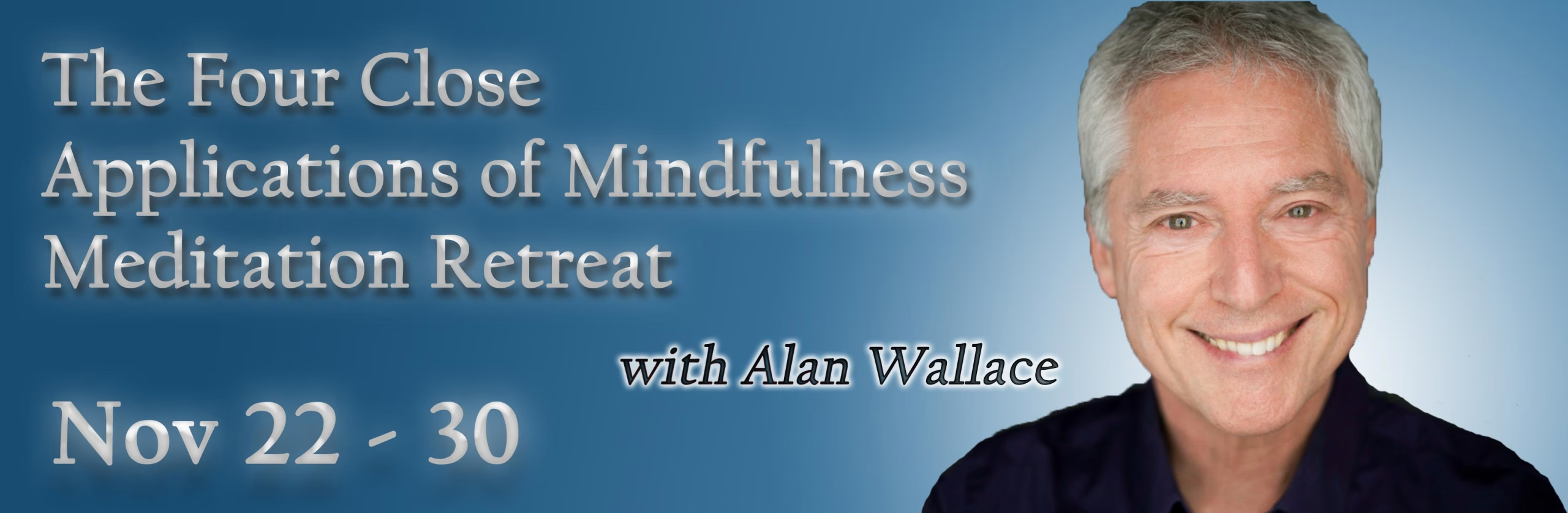
The Four Close Applications of Mindfulness with Alan Wallace
Suitable for beginners and experienced students!
Course Description
A central message of the Buddha’s teachings is that the mind is purified of its afflictions through the integrated cultivation of meditative quiescence (shamatha) and contemplative insight (vipashyana). During this seminar, we will focus on the four close applications of mindfulness, which form the foundation of Buddhist insight practice. These include mindfulness of the body, feelings, mental states, and mental objects. As we investigate the nature of these features of our existence, we will probe the very nature of human identity and the possibility of freedom.
A central theme will be the cultivation of discerning mindfulness, in which we will increasingly distinguish between phenomena presented to our senses and the conceptual projections that we impose on reality. Beginning with the four applications of mindfulness as taught in the Theravada tradition, we explore these practices as taught in the Mahayana tradition in accordance with the Madhyamaka view, and we will conclude with the cultivation of contemplative insight into the nature of the mind as taught in the Mahamudra and Dzogchen traditions.
The seminar will consist of lectures, guided meditations, and discussions led by Alan Wallace.
Reading List
The Attention Revolution: Unlocking the Power of the Focused Mind
Minding Closely: The Four Applications of Mindfulness
Course Donation
For this special retreat, the full donation amount will depend on the kind of room you will be allocated during Check In. It is not possible to request specific accommodation in advance so please do not email us to ask. Please read our explanation of our Room Allocation System as explained on our FAQ page.
Tushita Meditation Centre operates entirely on the basis of donations, most of which come from people attending our courses and retreats. We ask that you give your full donation for the course in Indian Rupees only (unfortunately we cannot accept Foreign Currency, Travellers Cheques or Credit Cards).
We have calculated the minimum amount that Tushita needs to cover our costs on this 9-day residential course, and we ask you to help us by offering at least this amount. The suggested donation for the entire 9-day course including accommodation and meals:
Big Dormitory (7-14 beds): 7950 IR
Small Dormitory (3-4 beds): 9150 IR
Single no toilet: 10,500 IR
Single with toilet: 11,400 IR
UPDATE: There are no more single rooms available! There is only Large Dormitory accommodation available now.
Tentative Course Schedule
Tentative Schedule for this silent retreat
| DAY 1 – CHECK-IN | |
| 1:00pm | Check-in |
| 4:30pm | Welcome and Introduction Talk |
| 6pm | Dinner |
| 7:30 – 9:00pm | Session |
| COURSE DAYS | |
| 6:45 – 7:30 | Session |
| 7:30am | Breakfast |
| 9:00 – 12:00pm | Session (with break) |
| 12:00pm | Lunch & Karma Yoga |
| 2:00 – 5:00pm | Session (with tea break) |
| 5:30pm | Dinner |
| 7:00 – 8:30pm | Session |
| LAST DAY – CHECKOUT | |
| 6:45 – 7:30 | Mindfulness Meditation |
| 7:30am | Breakfast |
| 9:00 – 12:00pm | Session |
| 12:00pm | Picnic Lunch |
| 1:00pm | Check-out |
Guidelines for Behaviour
Rules of Discipline
It is only possible to stay at Tushita if you are taking one of our residential courses/retreats or are an established Buddhist practitioner doing your own formal Buddhist retreat of a minimum of 10 days duration.
Since Tushita is a semi-monastic meditation centre and not a guesthouse, we ask all of our retreatants and visitors to observe the following rules of discipline in order to maintain an atmosphere conducive to inner reflection and meditation:
- Be considerate of the monks and nuns: dress respectfully (please no shorts above the knee, tank-top shirts or tight and revealing clothing).
- Respect all life: do not intentionally kill any living being, even small insects.
- Respect others’ property: do not steal or take anything not freely given.
- Be honest and straightforward: do not lie or intentionally deceive others. This is easy when observing silence!
- Be celibate: no sexual activity. This also includes no holding hands, hugging, massages and other physical displays of affection.
- Be alert and mindful: avoid intoxicants such as alcohol, drugs and cigarettes (we encourage you to stop smoking while here, but if this is impossible, one can smoke at a designated place at the centre boundary).
- Be considerate of others’ silence: keep silence in the appropriate areas and at all times during residential courses, especially in the Gompa and the dormitories. No singing or playing music and in general, maintain a quiet demeanor while on the property.
Basic Course Discipline
In order to keep the atmosphere conducive to inner reflection and spiritual pursuit and to minimise distractions during the course, students on our residential courses and retreats are asked to abide by our basic code of discipline listed below.
- Please be gentle in your behaviour and sensitive to fellow group members.
- Please settle all outside communication before the course begins. Telling friends and family that you will be out of contact for the duration of the course and sticking by that decision significantly reduces distraction from investigation into the workings of your own mind! Likewise, please settle your travel arrangements etc before you come to Tushita!
- You are expected to observe silence (no talking at all) from the evening of the first day until the end of the course.
- Do not leave Tushita property for the entire course.
- Participants must attend all sessions of the course and come to sessions on time.
- Please put all communication / entertainment devices (laptop / mobile phones /cameras / MP3/CD players) etc into our safe at check-in.
Gompa Etiquette
“Gompa” is a Tibetan word which we use for Meditation Hall. Because a Gompa is the location of study, meditation and devotional practices, Buddhists consider them to be holy places. In this tradition, the following modes of behaviour are considered respectful in a Gompa and we ask you to follow them while here:
- No idle chit-chat in the Gompa (ie. You can ask the teacher questions during class, but do not talk with other students).
- Do not point your feet towards the teachers, the altar or any holy object.
- Do not put Dharma materials – prayer books, texts, Dharma books or notebooks with Dharma in them – on the floor, or sit or step over them.
- Do not lie down or do any yoga exercises in the Gompa at any time.
Registration
Registration Now CLOSED. No deposits accepted